
QPerfect Research

Research

Explore the innovation behind QPerfect. Browse our collection of scientific publications and technical resources detailing the research at the core of our technology.

Optimized Matrix-Product State Simulations of Quantum Error Correction Circuits
Preprint

Optimized Matrix-Product State Simulations of Quantum Error Correction Circuits

Asier Piñeiro Orioli, Chen Zhao, Guido Masella, Tommaso Macrì, Hengyun Zhou, Shannon Whitlock

Simulating quantum error correction (QEC) circuits including non-Clifford gates at scale is important to accelerate progress toward fault-tolerant quantum computing. Here we demonstrate that matrix product state (MPS) techniques can handle many QEC circuits exactly and without restriction on gate…

arXiv preprint · 2026
Error-detected surgery on Iceberg codes
Preprint

Error-detected surgery on Iceberg codes

Andrea Di Fini, Samuel Crew, Laura Pecorari, Guido Pupillo

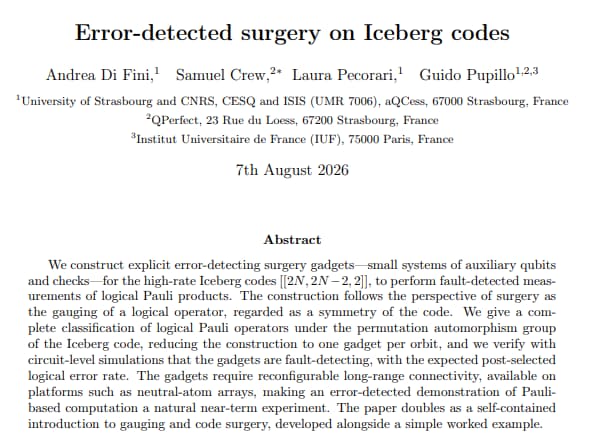
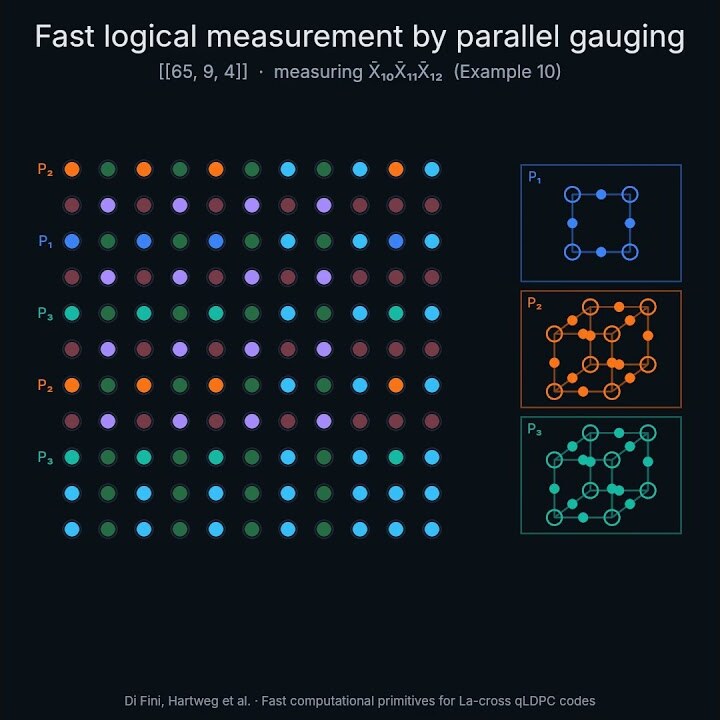
We construct explicit error-detecting surgery gadgets—small systems of auxiliary qubits and checks—for the high-rate Iceberg codes [[2N,2N-2,2]], to perform fault-detected measurements of logical Pauli products. The construction follows the perspective of surgery as the gauging of a logical operator, regarded…

arXiv preprint · 2026
Topological Recursion and Quantum Path Signatures
Preprint

Topological Recursion and Quantum Path Signatures

Inês Aniceto, Thomas Cass, Samuel Crew

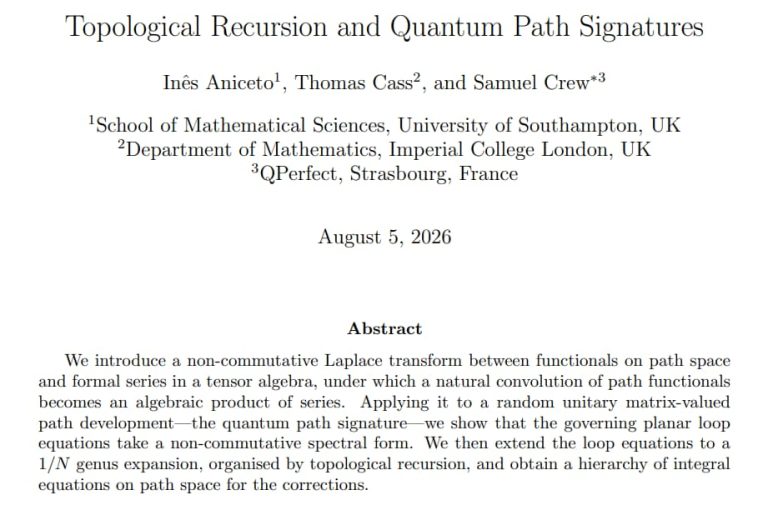
We introduce a non-commutative Laplace transform between functionals on path space and formal series in a tensor algebra, under which a natural convolution of path functionals becomes an algebraic product of series. Applying it to a random unitary matrix-valued path…

arXiv preprint · 2026
Efficient atom rearrangements for quantum error correction primitives with a single AOD
Preprint

Efficient atom rearrangements for quantum error correction primitives with a single AOD

Tom Hartweg, Asier Piñeiro Orioli, Hugo Perrin, Samuel Crew

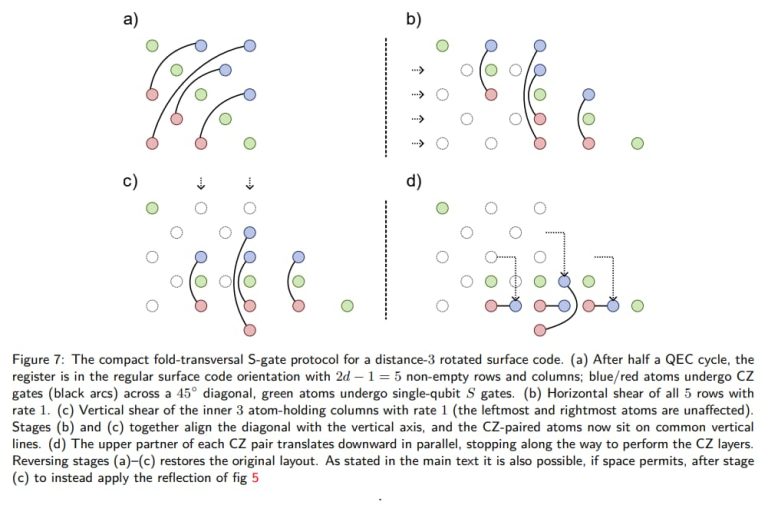
Neutral-atom quantum computers offer arbitrary connectivity enabled by atom transport. Some logical operations can then be simplified or reduced entirely to geometric rearrangements of the atoms. Minimizing the duration of these movements is therefore essential for high logical throughput. We…

arXiv preprint · 2026
Fault-tolerant quantum computation with static atomic buses
Preprint

Fault-tolerant quantum computation with static atomic buses

Matteo Bergonzoni, Laura Pecorari, Sam Norrell, Cody Poole, Guido Pupillo, Mark Saffman

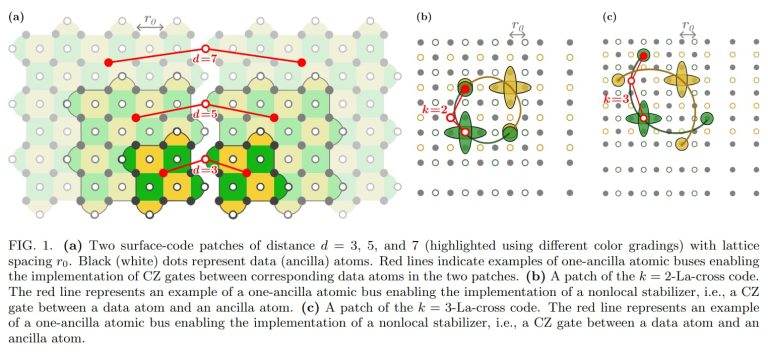
Efficient quantum error correction and fault-tolerant quantum computing require scalable, high-fidelity long-range connectivity. In neutral-atom quantum computers, this is commonly achieved through atom transport, but shuttling introduces latency and motional heating that worsen with system size. Here, we introduce a…

arXiv preprint · 2026
Tuning Quantum MPS
Preprint

Tuning Quantum MPS

Anna Leonteva, Maxime Outteryck, Guido Masella

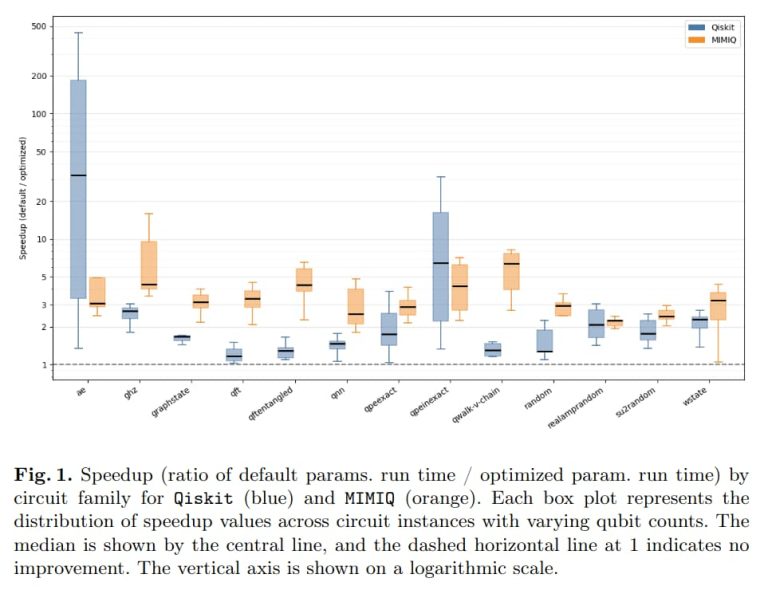
Matrix Product State (MPS) methods are among the most effective approaches for the classical simulation of quantum circuits, but their practical performance depends strongly on simulator hyperparameters, and default settings are often suboptimal. In this work, we propose a two-stage…

arXiv preprint · 2026
A quantum algorithm for one-shot signatures
Preprint

A quantum algorithm for one-shot signatures

Gopikrishnan Muraleedharan, Minh Thuy Truc Pham, Vir Pathak, Thomas Gardner, Chuanqi Zhang, QPerfect, Gavin K. Brennen

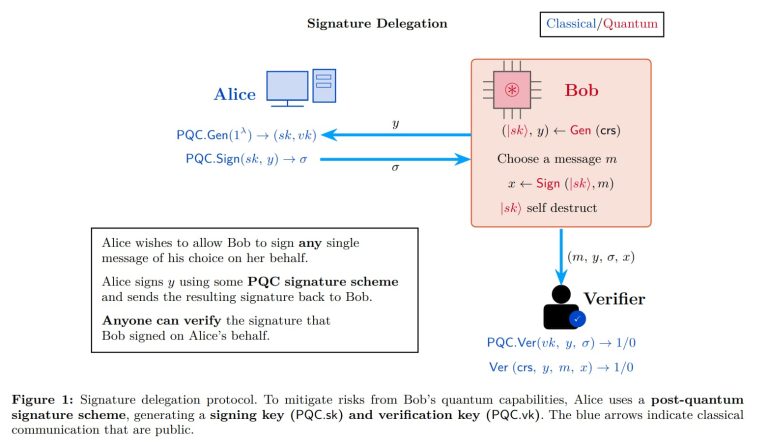
We provide a pre-obfuscation circuit-level implementation of an efficient one shot signature scheme, which has known applications to delegated signatures, secured token transfer, and publicly verifiable randomness. The algorithm consists of two stages: a key generation stage where a classical…

arXiv preprint · 2026
Correlated Atom Loss as a Resource for Quantum Error Correction
Preprint

Correlated Atom Loss as a Resource for Quantum Error Correction

Hugo Perrin, Gatien Roger, Guido Pupillo

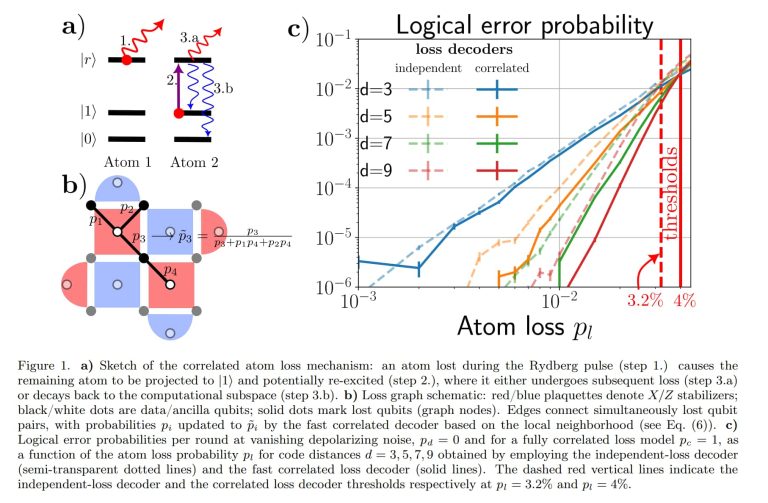
Atom loss is a dominant error source in neutral-atom quantum processors, yet its correlated structure remains largely unexploited by existing quantum error correction decoders. We analyze the performance of the surface code equipped with teleportation-based loss-detection units for neutral-atom quantum…

arXiv preprint · 2026
Noise tailoring for error mitigation and for diagnozing digital quantum computers
Preprint

Noise tailoring for error mitigation and for diagnozing digital quantum computers

Thibault Scoquart, Hugo Perrin, Kyrylo Snizhko

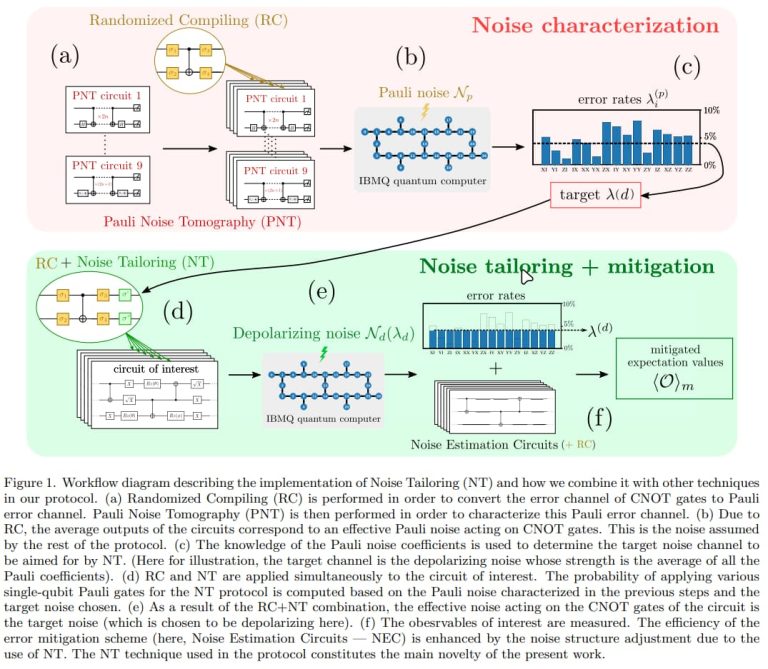
Error mitigation (EM) methods are crucial for obtaining reliable results in the realm of noisy intermediate-scale quantum (NISQ) computers, where noise significantly impacts output accuracy. Some EM protocols are particularly efficient for specific types of noise. Yet the noise in…

arXiv preprint · 2026
Quantum Emulator Benchmarking Made Easy
Publication

Quantum Emulator Benchmarking Made Easy

Anna Leonteva, Maxime Outteryck, Guido Masella

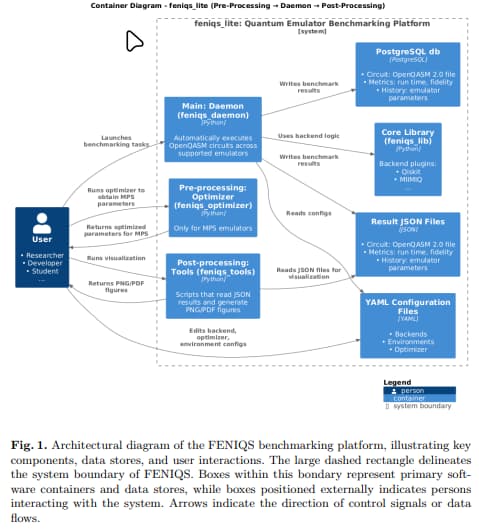
Classical quantum emulators are key tools for algorithm design, error correction, and noise mitigation. They rely on a variety of simulation methods such as statevector, tensor networks, matrix product states, decision diagrams and others. Their performance depends not only on…

QUEST-IS 2025 Proceedings (Springer) · 2025
Addressable gate-based logical computation with quantum LDPC codes
Preprint

Addressable gate-based logical computation with quantum LDPC codes

Laura Pecorari, Francesco Paolo Guerci, Hugo Perrin, Guido Pupillo

Quantum computing relies on quantum error correction for high-fidelity logical operations, but scaling to achieve near-term quantum utility is highly resource-intensive. High-rate quantum LDPC codes can reduce error correction overhead, yet realizing high-rate fault-tolerant computation with these codes remains a…

arXiv preprint · 2025
K-ADAPT-VQE: Optimizing Molecular Ground State Searches by Chunking Operators
Publication

K-ADAPT-VQE: Optimizing Molecular Ground State Searches by Chunking Operators

Tatiana A. Bespalova, Oumaya Ladhari, Guido Masella

Classical simulation of molecular systems is limited by exponential scaling, a hurdle quantum algorithms like Variational Quantum Eigensolvers (VQEs) aim to overcome. Although ADAPT-VQE enhances VQEs by dynamically building ansätze, it can remain computationally intensive. This work presents K-ADAPT-VQE, which…

arXiv preprint · 2025